Agriculture News

Agriculture News

Two Andhra women farmers to visit Europe, learn organic farming

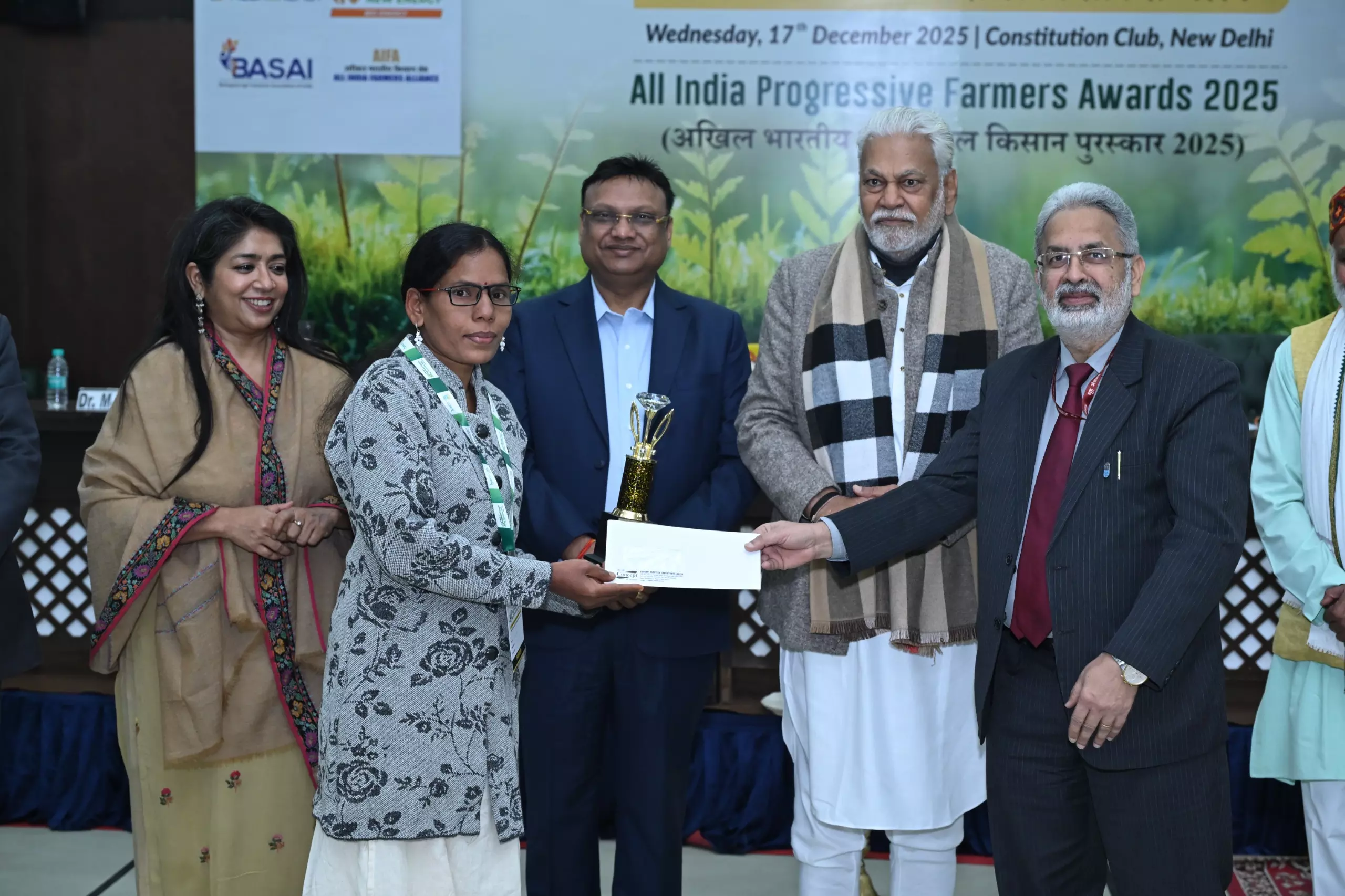
Amaravati: Two women farmers from Andhra Pradesh have been selected for a prestigious 30-day multi-country study tour of Europe, where they will engage with leading institutions, policymakers, and global platforms on natural and organic farming. Women at the forefront of natural farming The selected representatives are Arika Narasamma, a farmer-scientist from Durubili village in Kurupam mandal of Parvathipuram–Manyam district, and Lalam Jyothi, a community mentor from Santhapalem village in Rambilli mandal of Anakapalli district. Both are associated with the Andhra Pradesh Community-Managed Natural Farming programme (APCNF) and are known for achieving strong results through natural farming practices. Europe-wide engagement across Seven Countries The delegation will travel across Germany, Switzerland, the Netherlands, Poland, and Belgium, along with two other European nations, interacting with universities, research institutions, organic farmer networks, civil society platforms,s and policymakers.

Agriculture News

Women Leading Organic Farming Revolution In AP’s Tribal Districts

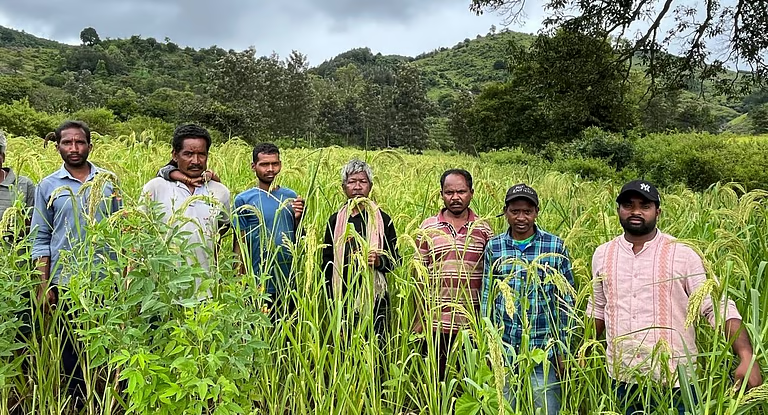
A quiet revolution is unfolding at the fields in the remote tribal belts of Alluri Sitarama Raju and Parvathipuram Manyam districts. Women, once confined to traditional roles, are now playing a leading role in organic farming, challenging the dominance of chemical fertilisers. In the process, they have gone on to prove that sustainable agriculture can be both profitable and empowering.

Agriculture News

AI graduate from Andhra Pradesh empowers tribal farmers with eco-friendly innovations

PARVATHIPURAM MANYAM; Gembali Gowtham, a 30-year-old Data Science and Artificial Intelligence graduate from Parvathipuram-Manyam district, is transforming agriculture through innovation. Despite hailing from a middle-class family in one of the State’s most underdeveloped regions, Gowtham has emerged as an inventor and entrepreneur, designed eco-friendly electric devices meant to ease the burden of small and marginal farmers and tribal communities. After completing his post-graduation from GITAM University and a master’s in AI in Mumbai, Gowtham initially pursued a career in software. However, his passion for practical solutions led him to leave his job and join Wassan India, a non-governmental organisation that focuses on sustainable agriculture in rainfed areas. At Wassan, he worked as a Research and Development Engineer, developing affordable agricultural tools aimed at empowering rural farmers. One of his key inventions is a mini solar water pump, designed specifically for tribal farmers in hilltop villages prone to wild elephant attacks. Gowtham’s innovation ensures that farmers have reliable access to water without incurring high costs. Another notable invention is the mini millet dehuller, particularly for tribal farmers. Resembling a mixer but functioning as a mill, it reduces the physical strain of manual dehulling and is priced to be affordable for small farmers. Additionally, the mini portable sprayer is designed to ease the workload for women farmers, weighing just 2 kg and capable of spraying up to 400 litres through a 200-foot hose with a single charge.

Agriculture News

For the tribal people of Andhra Pradesh, climate change is not just another environmental issue—it is a question of justice, survival and identity

Climate change is no longer a distant threat for the tribal communities of Andhra Pradesh—it is a lived reality. The high-altitude tribal areas and forests of Alluri Sitarama Raju, Parvathipuram Manyam districts, once abundant with crops, streams, and dense greenery, are showing visible signs of distress. Rising temperatures, erratic rainfall, and recurring forest fires are disrupting the delicate balance between nature and people that has sustained tribal life for millennia. The Andhra Pradesh State Action Plan on Climate Change (AP-SAPCC, 2020) and other study reports alert us to these climatic shifts which are hitting the poorest and most vulnerable the hardest—especially because they depend on rain-fed farming, forest produce, and traditional occupations. Agriculture in peril For tribal farmers, agriculture has always been closely tied to the rhythm of the monsoon. But today, that rhythm has vanished and been replaced with erratic and unpredictable weather patterns. Increasing heat has been reducing soil moisture, while unseasonal rains have been damaging standing crops. Those like paddy and pulses have been showing declining yields under heat stress, while traditional millets—long neglected—have proven more resilient. Studies by the Indian Agricultural Research Institute (2012) and the Indian Council of Agricultural Research (2019) show that millets can thrive even in low-rainfall years, making them vital for food security in dry upland regions. Water scarcity has also become acute. The AP-SAPCC (2020) predicts a steady decline in rainfall during key crop-growing months (Rabi). Sudden heavy downpours now cause soil erosion and flooding. Strengthening watershed management and restoring traditional tanks are critical to rebuilding water security in tribal villages. For instance, a survey undertaken by Laya, a tribal resource centre, on the existing water harvesting structures including check dams, streams, and tanks meant for irrigation purposes in ASR and Manyam districts —revealed that they were about 81 in number and collectively catered to an extent of only 177 as opposed to 6,918 acres.  Most of the check dams that have been constructed have remained non-functional. If repaired, they are likely to provide irrigation facilities to a larger extent from the existing 2.5 per cent! Therefore, the revival of traditional water-harvesting structures such as check dams and percolation ponds must be actively taken up under schemes like Mahatma Gandhi National Rural Employment Guarantee Scheme (MGNREGS). Livestock and fisheries, which serve as important resources for rural nutrition and income, are also under stress as an effect of Climate Change. Hotter temperatures reduce milk yield and fertility in cattle, while irregular rainfall affects fish breeding in inland waters, as reported by the National Bank for Agriculture and Rural Development (2019). Additionally, runoff from fields containing residual chemical fertilisers and pesticides is further exacerbating the problem, underscoring the urgent need for adapting organic farming practices.


Agriculture News

50k farm ponds built so far in Andhra; ASR, Parvathipuram lead drive

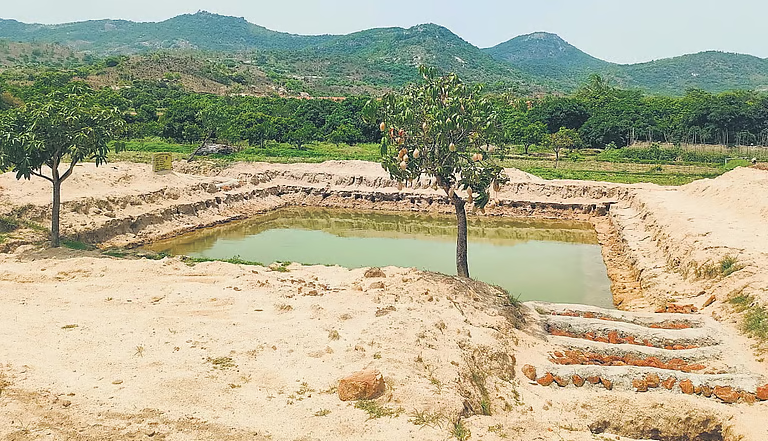
VIJAYAWADA: The State government, which aimed to complete 1.55 lakh farm ponds, has so far constructed 50,000, with Alluri Sitarama Raju (ASR), Parvathipuram Manyam, and Annamayya districts leading the progress. According to Panchayat Raj and Rural Development Commissioner VR Krishna Teja, 7,566 farm ponds were completed in the ASR district, 6,317 in Parvathipuram Manyam, and 5,181 in Annamayya district. Calling farm ponds the ‘Sanjeevani’ of agriculture, Krishna Teja said that they enable the cultivation of crops like papaya, banana, guava, and curry leaves. Fish farming is also possible in them, he added. As the State is experiencing pre-monsoon rains, the commissioner urged farmers to grow vegetables along the pond bunds to earn additional income. He said seeds for vegetables and leafy greens are being distributed under the National Rural Employment Guarantee Scheme (MGNREGS). The Panchayat Raj and Rural Development Commissioner noted that each pond can store up to 1.80 lakh litres of water, and collectively, the planned 1.55 lakh ponds can hold nearly 1 TMC of water. Built at no cost to farmers under the MGNREGS, each pond saves about Rs 50,000 in construction expenses.

Agriculture News

Wife’s knee pain moves AP farmer to design home escalator

RAJAMAHENDRAVARAM: Love does not always find expression through grand monuments. Sometimes it quietly takes the shape of a simple machine built with care, determination and imagination. That is exactly what 65-year-old farmer Satti Siva Narayana Reddy of Arthamuru village in East Godavari district, about 35 kilometres from Rajamahendravaram, has done for his wife Satyaveni, 58, who has been suffering from severe knee pain. Without any engineering degree or formal technical training, Reddy designed and built a homemade escalator to help his wife climb the 21 steps to the first floor of their house. The project took just 20 days to complete and cost only Rs 70,000. Arthamuru, located near Mandapeta in the fertile Godavari delta, is surrounded by green paddy fields and irrigation canals. Reddy studied up to Class V because the nearest school was too far from his village. His fascination with machines began in childhood, and years of working with agricultural equipment helped him develop skills. Today he owns four tractors and a rice mill, cultivates five acres of farm, and repairs tractors, rice mill machine and agricultural equipment on his own. Speaking to TNIE, Reddy recalled how his wife’s daily struggle to climb the staircase affected him. “We live on the first floor because Vastu experts advised that the house owner should stay upstairs. Every day, I watched my wife suffer while climbing the steps. One day, she said, ‘You are a technician. Why don’t you make something like a lift for our house?’ Those words stayed with me,” he said.

Agriculture News

Wild elephants trample tracker to death in Andhra Pradesh

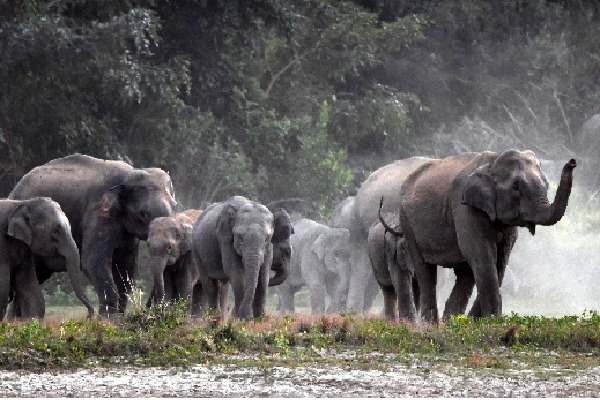
Visakhapatnam, Feb 7: A herd of wild elephants trampled to death a tracker in Andhra Pradesh’s Parvathipuram Manyam district, officials said. Lakshminarayan (26), who was trying to prevent tuskers from entering a village, died on the spot. The incident occurred on Monday night on the outskirts of Pasikudi village in Parvathipuram Manyam district. The youth, who was working with the forest department on a contract basis, was trying to prevent the herd of elephants from entering cotton fields in the village. According to forest officials, using a fire torch, he tried to drive the tuskers towards the Vamsadhara river. The jumbos, however, charged at him forcing him to run for cover. The herd trampled him after he fell on the ground. Lakshminarayan, a resident of Srikakulam district, died on the spot. Villagers in the region were panicked by the incident. Senior forest officials rushed to the spot and assured people that steps will be taken to control the wild elephants, which have been creating havoc in the region for the last few weeks. This is the second death caused by the wild elephants in the district in three months. A farmer was trampled to death by a wild tusker in Kallikota village in the same district in November last year. The 48-year-old farmer had gone to his farm field to take stock of the water level there when a lone elephant attacked him and trampled him to death.

Home
menus
news
contact